
How to Teach Your Dog to Sit (Without Pushing on Their Bottom)
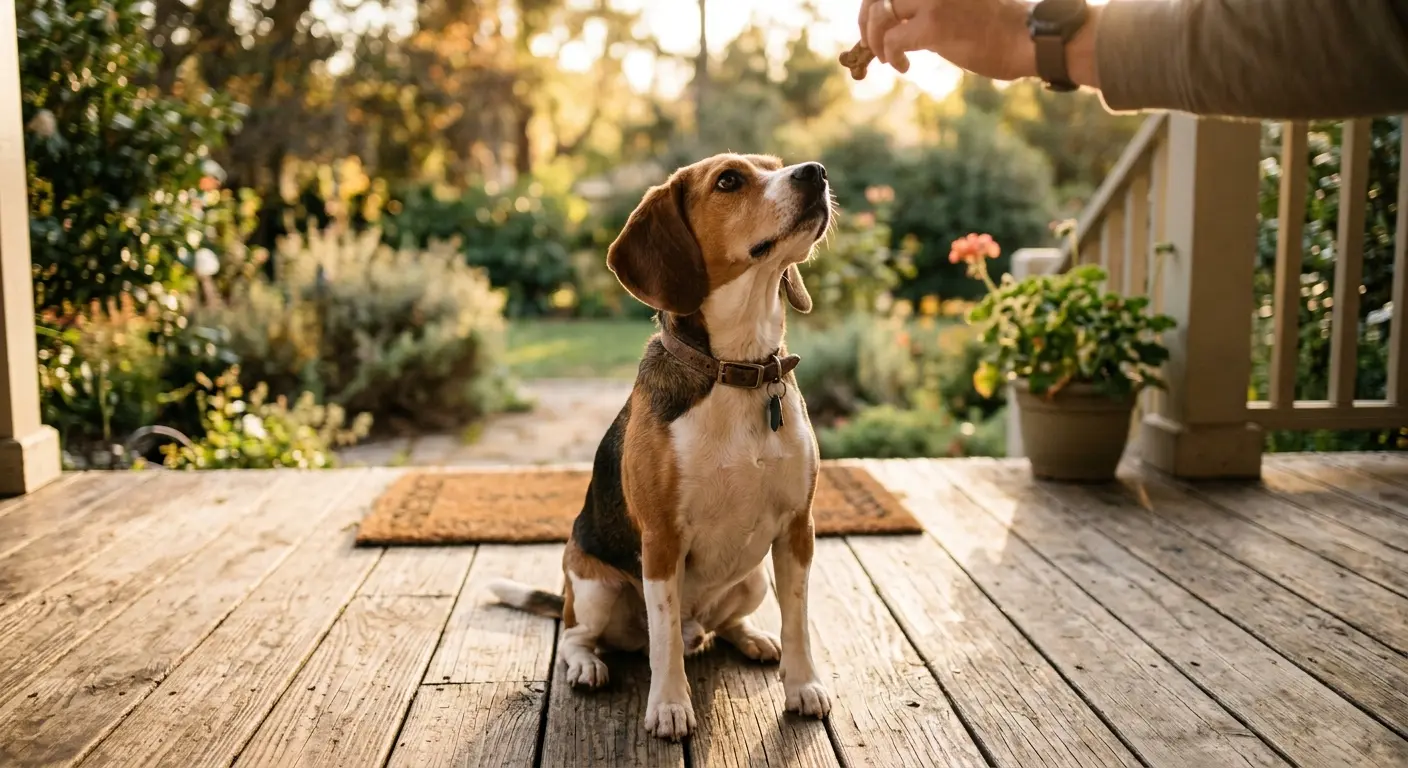
Sit is usually the very first thing anyone teaches a dog, and for good reason: it’s a simple, polite default that keeps four feet on the floor and a busy brain occupied. A dog who knows sit has an easy answer to “what should I do right now?” — at the door, at the kerb, before dinner, when a stranger wants to say hello.
The good news is that almost every dog will sit for you within a single session. The trick is teaching it in a way that’s fast, force-free, and reliable enough to survive real life — not the old “press on the back end” method, which teaches your dog very little and can make sitting feel unpleasant.
Don’t push your dog into a sit
Let’s clear this one up first, because it’s the most common mistake: never push down on your dog’s rear to make them sit. It doesn’t teach them what the word means — it just teaches them to brace against your hand. For some dogs it’s uncomfortable, for others it turns into a pushing game, and for a few it’s a genuine strain on the hips.
You want your dog’s bottom to hit the floor because they chose to sit and got paid for it. That’s what makes the behavior stick.
Method 1: Luring (the quickest way)
Luring uses a treat to guide your dog into position. It works because of simple physics — when a dog’s nose goes up and back, their bottom goes down.
- Hold a small, soft treat right at your dog’s nose so they can smell it but not snatch it.
- Slowly move the treat up and back over their head, toward the space between their ears. Their nose follows it up, and their rear naturally lowers.
- The moment their bottom touches the floor, mark it — a cheerful “yes!” or a clicker — and feed the treat.
- Encourage them back up and repeat five or six times.
Keep the treat close to their nose. If you hold it too high, most dogs jump for it instead of sitting; if that happens, lower your hand. If they back up instead of sitting, practice with a wall or a corner behind them so there’s nowhere to go but down.
Method 2: Capturing (for the naturally busy dog)
Some dogs won’t follow a lure, and some sit constantly on their own. For them, capture the sit instead: simply wait, treat in hand, and the instant your dog sits of their own accord, mark and reward. Do this a few times and most dogs quickly start offering sits on purpose to see if it pays again. It’s slower to get going than luring, but it teaches your dog to think, which is no bad thing.
Fade the lure fast
Here’s the step people skip, and it’s the one that matters most: stop using food to lure within a session or two. If the treat is always in your hand, it stops being a reward and becomes a bribe your dog waits for — and a dog who only sits when they can see a treat hasn’t really learned sit.
After a handful of successful lures:
- Make the same hand motion with an empty hand, and reward from your other hand or a pouch once they sit.
- Shrink the motion over a few reps until it becomes a small hand signal — an upward flick of the hand is a perfectly good “sit” cue on its own.
Add the word
Once your dog is reliably sitting from your hand signal, you can attach the cue. Say “sit” once, in a normal voice, just before you give the hand signal. The order matters: word first, then the motion your dog already understands. After enough repetitions, the word alone will predict the sit, and you can drop the hand signal if you like.
Say it once. Repeating “sit, sit, sit” teaches your dog that the cue is a background hum they can ignore until the third or fourth time.
Keep it working in the real world
A sit in your quiet kitchen is not yet a sit at the park. Dogs don’t automatically generalize, so practice in gradually harder places:
- New rooms, then the garden, then the front step, then the pavement.
- Standing, sitting, or turned slightly away from your dog.
- Around mild distractions first, building up to bigger ones.
As it gets more reliable, you don’t need to treat every single sit — but keep rewarding often, especially the fast, snappy ones, so sitting always feels worth it.
Quick troubleshooting
| What’s happening | Likely cause | Fix |
|---|---|---|
| Dog jumps up at the treat | Lure held too high | Keep it low, right at the nose |
| Dog backs up instead of sitting | Nothing behind them | Lure them with a wall or corner behind |
| Only sits when they see food | Lure never faded | Switch to an empty-hand signal, reward after |
| Ignores the word | Cue said too often, or added too early | Say it once, and only after the hand signal is solid |
Keep sessions short and happy
Two or three minutes, a few times a day, beats one long drill. End while your dog is still enjoying it, always on a sit they nailed. Taught this way — with a lure faded early and a word added at the right time — most dogs have a happy, reliable sit within a few days.
Let Ruffy guide the way
Sit is the first of many cues, and each one goes smoother when you know the exact next step. The Ruffy app breaks skills like this into short, force-free, guided sessions that adapt as your dog learns — so you always know when to fade the lure, when to add the word, and where to practice next.
Download Ruffy free and teach your dog to sit the way that lasts. 🐾
Keep reading
How to Teach Your Dog to Lie Down (the 'Down' Cue)
Down is the calm off-switch of dog training — for the vet, the café, the front door. Here's the force-free way to lure it, fade the treat, and add the word so it actually holds.
How to Teach Your Dog to 'Leave It' (a Cue That Can Save Their Life)
Dropped pills, chicken bones on the pavement, something dead in the grass — 'leave it' is the cue that stops your dog before they grab it. Here's the force-free way to build it, and why it works better than snatching things away.
How to Teach Your Dog to Stay (the Three D's Method)
A reliable stay isn't about your dog freezing on command — it's a skill you build in three directions. Here's the force-free method trainers use, step by step, with the mistakes that quietly undo it.